

Key takeaways
-
An IOLTA account is a pooled trust account holding unearned client funds (retainers, settlement proceeds) separate from a firm's operating account, with interest going to state legal aid programs rather than the lawyer or client.
-
Nominal or short-term funds belong in a pooled IOLTA; larger or longer-held client funds typically warrant a separate interest-bearing trust account so the client directly benefits from the interest.
-
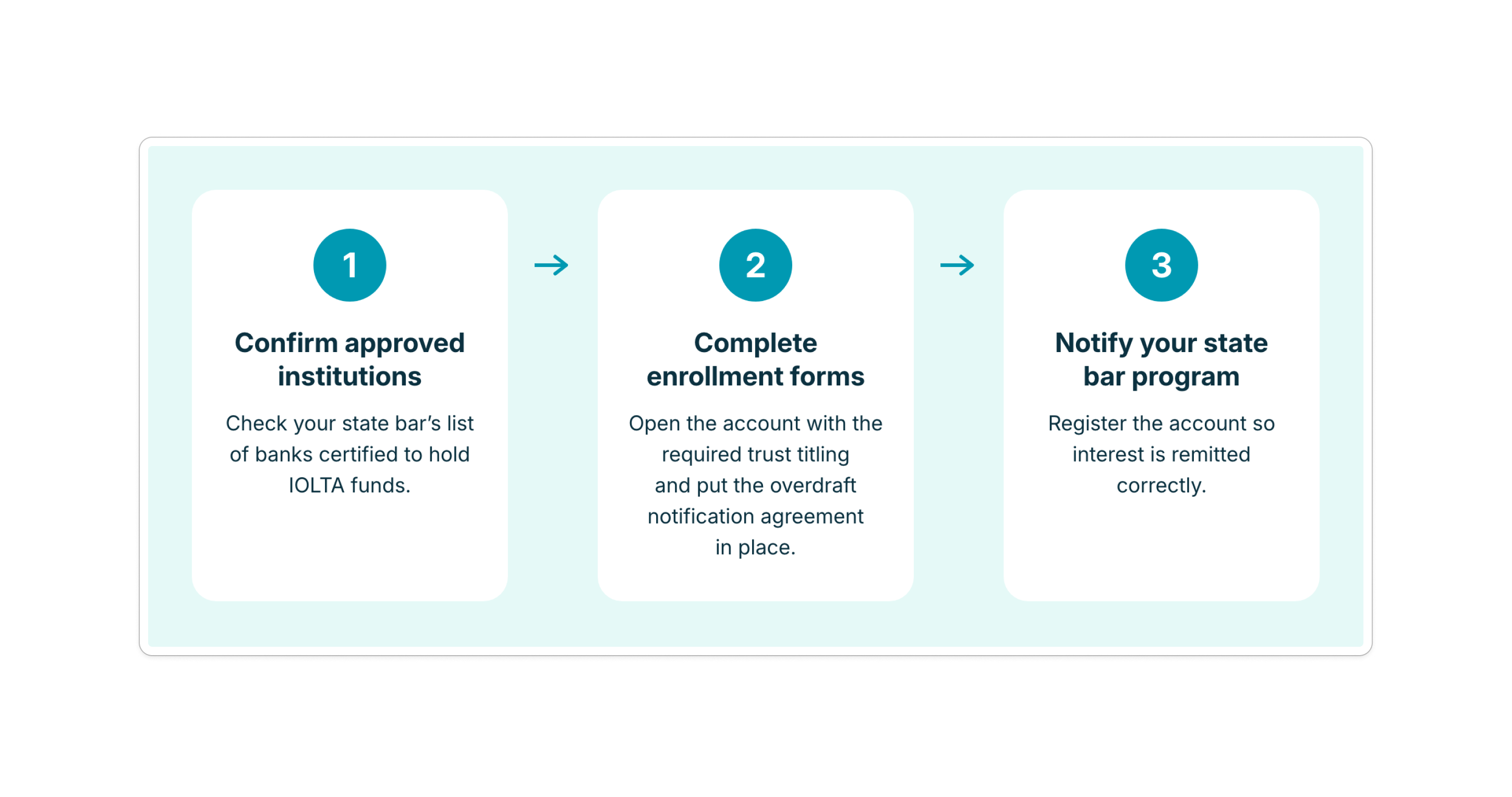
Opening an IOLTA requires state bar enrollment, an approved financial institution, and adherence to your state's specific reporting and recordkeeping rules, which vary by jurisdiction.
-
49% of law firms say managing trust accounting is a significant or moderate challenge, and only 37% use trust accounting software, according to the 8am™ 2025 Legal Industry Report.
Legal accounting is notoriously complex, and many attorneys receive little training in properly managing an IOLTA (Interest on Lawyer Trust Account). Law firms must follow strict rules for handling client funds, and requirements vary slightly between state bar associations. Every lawyer is required to deposit unearned client funds into a separate trust account, commonly called an IOLTA. Mismanaging or commingling these funds can result in serious consequences, including reprimand or disbarment.
Even a single honest mistake can damage your reputation and erode client trust in an instant. Understanding how IOLTAs work, following state-specific best practices, and using the right tools helps your firm stay compliant and focus on serving clients well.
What is an IOLTA account?
An IOLTA is a trust account that holds client funds you have not yet earned, including retainers, settlement proceeds, and court-related fees. You keep these funds separate from your firm's operating or personal accounts to meet ethical and regulatory requirements, and you cannot personally profit from any interest the account generates. This obligation applies to every retainer and settlement payment your firm receives, regardless of the amount.
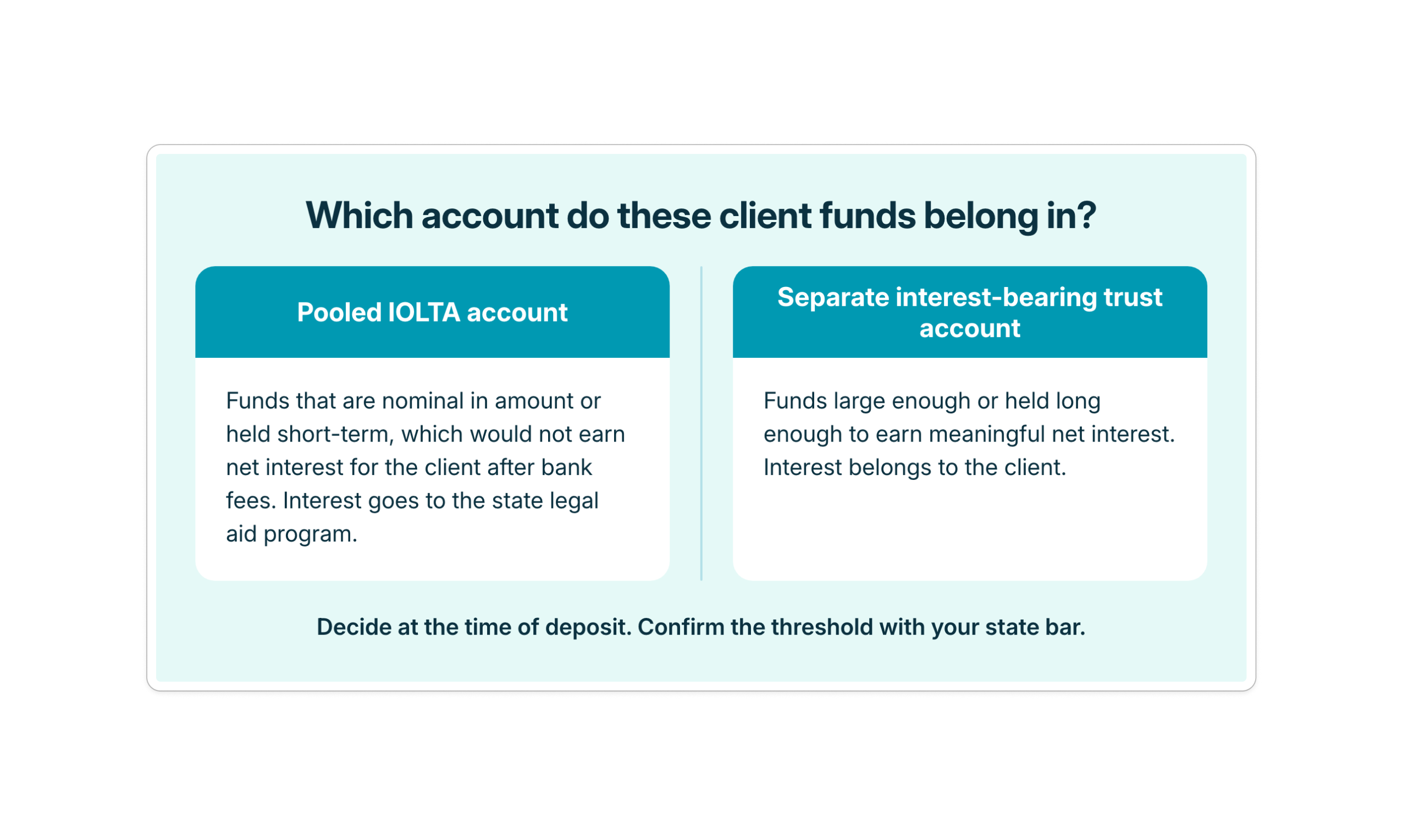
Bar associations created IOLTA programs to solve a simple problem: a single client's retainer usually isn't large enough to earn meaningful interest on its own. By pooling many clients' short-term funds into one interest-bearing account, the combined interest becomes worth collecting. Instead of going to the lawyer or the client, it funds legal aid and access-to-justice programs run by state bar associations.
Knowing which account type applies to which funds protects you from compliance risk. Misclassifying a retainer or mixing account types, even briefly, can trigger a bar complaint regardless of intent. The distinctions below matter most when you're deciding where a payment belongs before it ever touches your books.
Difference between IOLTA vs IOLA
IOLTA and IOLA (Interest on Lawyer Account) serve the same function: holding client funds you have not yet earned. The difference is geographic—most states use the term IOLTA, while New York uses IOLA. The compliance obligations behind each term are functionally identical.
Difference between IOLTA vs attorney trust account
Attorney trust accounts hold substantial or long-term client funds, with interest accruing directly to the client. The distinction between an IOLTA and a standard attorney trust account comes down to who benefits from the interest: public service programs for IOLTA, the client for a standard trust account. Firms that hold client funds for the long term, such as in a real estate closing or an estate matter, typically use a standard trust account rather than an IOLTA.
Difference between IOLTA vs escrow account
Escrow accounts hold funds in a neutral manner until specified conditions are met, with interest distribution determined by the escrow agreement. As with attorney trust accounts, the key difference from an IOLTA is the interest beneficiary: public service programs benefit from IOLTA interest, while designated parties benefit from escrow account interest.
When is an IOLTA account used?
Any time a law firm accepts payments for retainers from clients or handles money on a client's behalf, that money goes into an IOLTA account. Legal fees that aren't part of a retainer can generally go directly into an operating account since the payment isn't for future work.
While any unearned client money must be deposited into a trust, using an IOLTA specifically may or may not be mandatory, depending on the rules in your state. Check directly with your state bar association or a legal accounting expert to confirm whether using one is required for your practice. That said, given that an IOLTA account raises money for a number of worthy causes, it's almost always beneficial to use one when your state permits it.
How do IOLTA accounts work?
An IOLTA functions like any other trust account on the surface, but the mechanics behind it are what keep your firm compliant. Your bank pools client funds from multiple IOLTA-eligible deposits into a single interest-bearing account. The bank calculates interest on the pooled balance and remits it directly to your state's bar foundation or legal aid program, not to your firm or your client. In practice, this means your firm holds the principal in trust, tracks each client's portion through individual ledgers, and never touches the interest.
To understand how this plays out in practice, walk through a simple example:
-
Client payment: Client A signs a retainer agreement and pays a $7,000 retainer to secure your legal services. That money is placed into your IOLTA account because it hasn't been earned yet; it's considered unearned and must remain separate from your business funds.
-
Work begins : A week later, you work 4 hours on Client A's case at $120/hour, totaling $480 in legal fees.
-
Client approval: Even after the work is complete, you can't withdraw the $480 until Client A reviews and approves the invoice. Only then is the amount considered earned.
-
Fund transfer: Once approved, you transfer the $480 from the IOLTA account to your firm's operating account. The remaining $6,520 stays in trust until additional work is completed and billed.
Every one of these steps needs its own documentation. Regulators expect a clear paper trail showing when funds moved, why, and at whose direction.
4 tips for following IOLTA account rules
Managing an IOLTA account well takes deliberate, ongoing attention, not just careful setup at the start. There are strict rules governing how the money in these accounts must be used and recorded, and even a firm with a dedicated accounting team must take deliberate steps to maintain IOLTA compliance . Solo attorneys and small firms carry the same obligations with fewer resources to catch mistakes before they cause harm.
It's also worth remembering that a lawyer is always on the hook for misusing IOLTA funds, even when the mistake is made by a bookkeeper or paralegal.
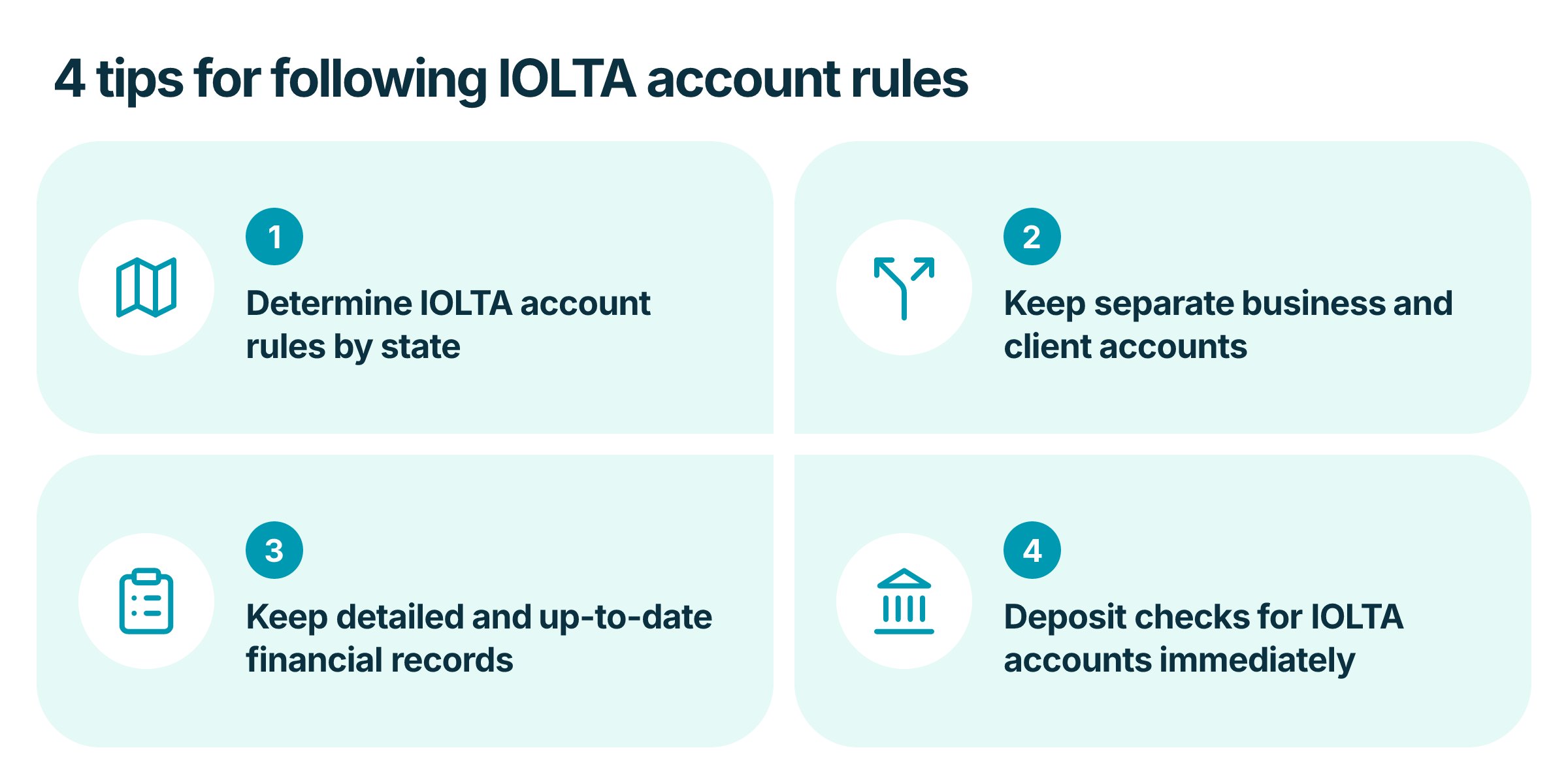
Here are four law firm accounting best practices to keep in mind so you always handle an IOLTA account properly.
1. Determine IOLTA account rules by state
IOLTA regulations differ across states, each with its own rules for managing client funds. Variations show up in reporting requirements, how nominal or short-term funds are treated, and when money must go into an IOLTA versus an individual client trust account. Some states require periodic reporting to the state bar; others set specific client notification procedures.
Despite these differences, common threads run through every IOLTA program. Accounts clearly labeled as trust or client accounts, strict separation from personal or business funds, detailed record-keeping, and interest directed toward legal aid and public interest programs. Confirm the specific requirements in your jurisdiction with your state bar association, since a compliance failure can trigger scrutiny even when the mistake was unintentional.
2. Keep separate business and client accounts
Commingling funds from a firm's operating account and a client trust account is prohibited under state ethics rules. The distinction gets confusing once earned fees start moving, so watch for these common mistakes:
-
Borrowing from an IOLTA: Retainer money isn't a stopgap for firm expenses. It stays off-limits until work is completed, billed, and approved, and even then, it must be transferred to the operating account before it's spent. Watch any IOLTA debit card closely, since a direct withdrawal bypasses that transfer step entirely.
-
Depositing client funds into a business account: If a client pays combined attorney fees and court filing fees in one payment, the entire amount goes into the IOLTA first, even if the filing fee itself is minor.
-
Charging payment fees to an IOLTA: Processing fees and account maintenance charges must come out of the operating account, never the trust account.
Keeping business and trust accounts separate reduces your compliance risk, but state-specific requirements for establishing and administering an IOLTA still call for a conversation with your bar association or an accounting expert.
3. Keep detailed and up-to-date financial records
Firms run into trouble when they don't keep detailed financial records of every client's trust account activity. That means separate ledgers for each client and a record of every transaction, however small, entered the moment it happens rather than reconstructed later.
A double-entry accounting system catches errors before they compound and gives you a clean trail if your state bar requests one. Manual tracking makes that a heavy lift; legal billing software like LawPay automates the entry and reconciliation work behind it.
4. Deposit checks for IOLTA accounts immediately
Attorneys need an accurate, current record of where client funds sit at any given moment. More firms now accept payment electronically , but some clients still prefer to pay by check. Deposit those checks right away. A retainer check isn't your firm's money yet, and that money must stay accessible to the client without delay.
Ensure IOLTA account compliance with LawPay
Legal billing software like LawPay removes much of the manual work behind IOLTA record keeping and compliance, so you can manage your client trust without second-guessing every transaction. It applies consistent payment processing rules to every transaction, the kind of consistency a manual process can't guarantee.

Trust accounting remains one of the harder parts of running a law firm. According to the 8am 2025 Legal Industry Report , 49% of law firms say managing trust accounting is a significant or moderate challenge, and only 37% use trust accounting software.
LawPay was built in cooperation with bar associations and ethics committees, so payments post correctly and align with your state's IOLTA guidelines.
-
Automatic separation of earned and unearned funds: LawPay connects to your trust and operating accounts, keeping earned and unearned funds separate by default. Payment processing rules automatically move funds to the correct account, so you don't have to decide case by case where a payment belongs. In fact, Smith & Eulo Law Firm , which uses LawPay, claims one of its firm's biggest advantages is the ability to properly separate trust and operating account payments while maintaining compliance with Florida Bar requirements. That kind of separation matters for any practice handling retainers, settlement funds, or court costs, regardless of size or practice area.
-
Streamlined record keeping: Every transaction gets a detailed, timestamped record. Link multiple trust and IOLTA accounts into LawPay for one consistent view of client funds and operating costs in real time, so small gaps in your records don't turn into larger problems if a bar audit or client inquiry requires proof of how funds were handled.
-
Compliant payment processing practices: Processing fees, including third-party fees, can't be paid from a trust account. LawPay blocks debits from your trust account for any reason and tracks all processing fees to your operating account automatically at the end, keeping your trust account clean and your operating account accountable.
-
Improve compliance with existing software: With integrations across the best law firm accounting software and legal operations tools, LawPay adds a layer of security to the systems you already rely on, so payment records, matter data, and books stay aligned without re-entering the same transaction twice.
When it comes to effectively managing an IOLTA account, your law firm can't afford to take risks. Schedule a demo to find out how LawPay can help you manage your trust accounts, minimize compliance risk, and give you more time to focus on your clients.
About the author

M.E. Hammond Senior Content Strategist and Blog Specialist 8am
Mary Elizabeth Hammond is a Senior Content Strategist and Blog Specialist for 8am, a leading professional business solution. She covers emerging legal technology, financial wellness for law firms, the latest industry trends, and more.