

Starting your own law firm can be an exciting journey. Some lawyers make the jump to practice to take control of their financial futures, while others want to be particular about the cases they accept. Whatever your motivation for starting a law firm , you need the right plan in place to succeed.
This guide outlines the questions you’ll answer, the funding you’ll need, and the steps you’ll take as you launch your legal practice. 8am owns and operates LawPay and MyCase, which we mention in this guide. We encourage you to compare your options and choose the tools that fit your firm best.
Law firm launch steps at a glance
Every law firm starts with a plan. These steps can help you get started on the right foot.
-
Assess your readiness
-
Create a business plan
-
Choose your office space
-
Form an entity
-
Bank accounts and insurance
-
Establish your brand
-
Staffing
-
Succession planning
-
Design your technology stack
Download this helpful law firm startup checklist to get started on your journey to starting a law firm: How to start a solo practice law firm .
1. Assess your readiness to run your own firm
Evaluating your own readiness is a practical first step. When you manage a law firm , you’re responsible for all aspects of the business—marketing, budgets, hiring, taxes, and everything in between. The job can be both rewarding and demanding, depending on your outlook and work ethic.
Self-assessment begins with analyzing some pros and cons to ensure this path makes sense for you.
The advantages of running your own firm include:
-
More control. You have freedom and control to work when you want.
-
Specialization. You can choose the case types and volume of cases you want to handle. This is beneficial for both clients and lawyers .
-
Financial advantage. Launching your own firm is less expensive than buying a law firm , due to virtual office options and technology. Plus, you keep all the earned profit.
Some areas you may find more challenging are:
-
Greater responsibility. You get to secure new clients, develop and follow the business plan, and hire your own staff .
-
Different working environment. You may spend more time working by yourself, with less access to mentorship from senior colleagues.
-
Coordination. Coordinating coverage for your clients while you’re out of the office may be more difficult.
-
Cash flow. Stabilizing the business so it’s generating regular cash flow may take some time.
The trade-off comes down to financial opportunity for increased responsibility. Many lawyers willingly accept the drawbacks for the upside. It can be a fulfilling journey if you have the right education, finances, and temperament.
Education requirements
Only licensed attorneys can start law firms. States define the exact requirements, such as:
-
Juris Doctor (JD) from an ABA-accredited law school or a California-accredited law school in California
-
JD from a non-ABA law school in Alabama, Connecticut, Massachusetts, and West Virginia (under specific conditions).
-
Completing a legal apprenticeship, also known as "reading the law', in lieu of attending law school in California, Virginia, Vermont, and Washington
-
A combination of law school and apprenticeship in lieu of a full JD program in Maine and New York
Review your state's current education requirements for opening a law firm. Note that in most states, you will also need to pass an ethics exam called the Multistate Professional Responsibility Exam (MPRE).
Financial readiness
How much does it cost to start a law firm? There are two main cost components to consider. First, you will fund one-time and ongoing costs for launching and running the business. Then, you need enough cash on hand to cover your personal expenses until the business starts generating consistent revenue.
The information in this section, including the scorecard, is for general educational purposes only. It isn’t financial, tax, or legal advice, and all dollar amounts are estimates. Your situation will be different, so talk with a qualified accountant, financial advisor, or attorney before you make decisions about funding your firm or leaving your current job.
Law firm start-up costs
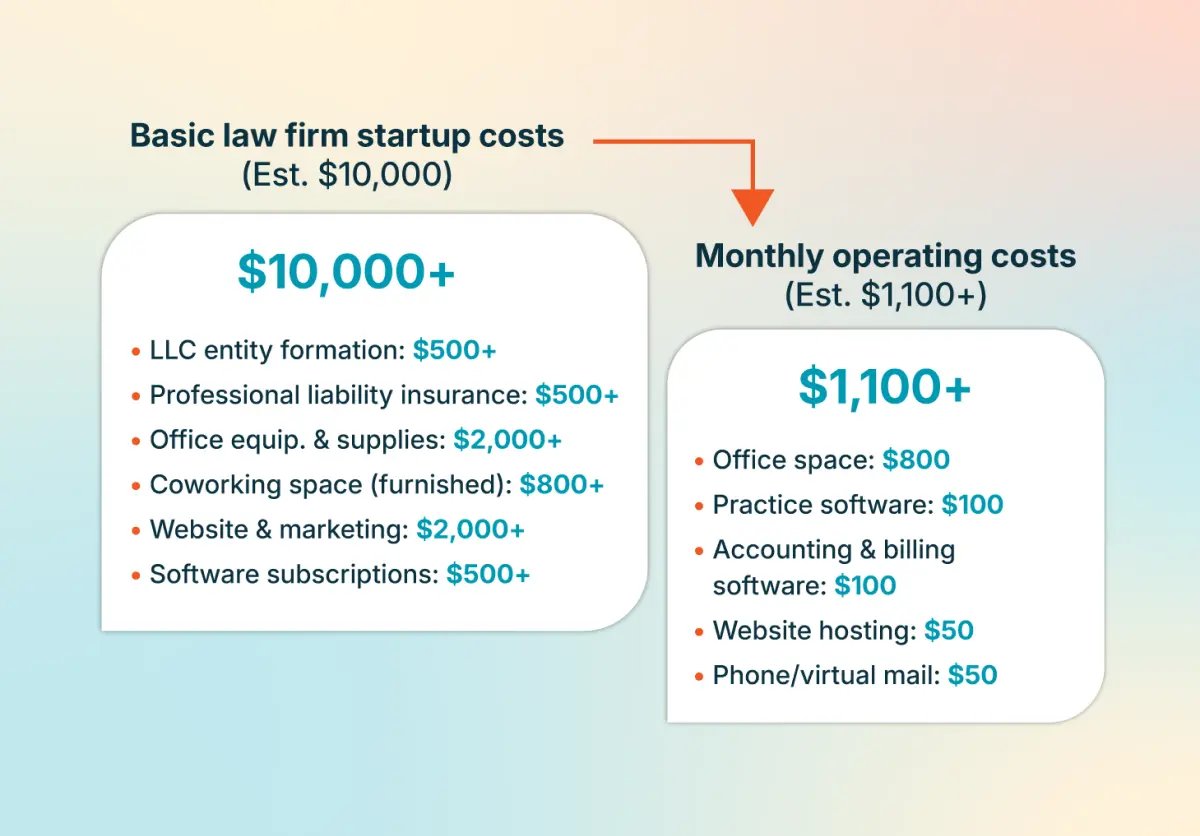
Depending on where you live and what you choose for office space, basic law firm startup costs can be roughly $ 10,000. Here are some of the components:
-
LLC entity formation costs ($500+)
-
Professional liability insurance ($500+)
-
Office equipment and supplies, including computers, phones, and stationery ($2,000+)
-
Furnished office space in a coworking facility ($800+)
-
Website development and marketing efforts ($2,000+)
-
Software subscriptions ($500+)
In addition, you’ll have monthly operating costs, such as:
-
Office space ($800)
-
Practice software ($100)
-
Accounting and billing software ($100)
-
Website hosting ($50)
-
Phone number and virtual mailing address ($50)
These could cost $1,100 or more monthly, depending on the type of office space you choose. All of the costs listed here are estimates only. Your actual costs will vary based on your location, practice area, and the choices you make for your firm.
Determining your income needs
The highest cost for the new business will probably be your income. To estimate your income needs, pull up your latest bank statements and add up what you’re spending on:
-
Mortgage or rent plus insurance
-
Utilities
-
Groceries and dining out
-
Car payments, gas, auto insurance, public transit, parking
-
Health insurance premiums, prescriptions, and copayments
-
Debt payments
-
Retirement contributions and savings deposits
-
Haircuts, clothing, streaming services, gym membership, and entertainment
The total is roughly how much you need to be financially stable. Adding $1,000 to $2,000 to that total provides an extra cushion for unexpected emergencies. For example, if your monthly expenses total $5,000, you might target a monthly income of $7,000.
Add in your estimated business operating expenses to get to your target revenue from the firm. If you assume $1,000 for operating expenses and $7,000 for your take-home pay, your target monthly revenue is $8,000. You can then apply your billing rate to determine the minimum number of hours you should bill each month. In this case, if you intend to bill $200 per hour, you need to bill at least 40 hours per month.
For more information, check out our charts of average hourly lawyer rates , organized by city and state.
Funding a new law practice
Knowing how much capital you need is only half of the funding equation. The other half is determining where the money comes from. Nearly every state prohibits nonlawyers from ownership in law firms, so outside equity financing isn’t an option. You’ll likely rely on savings, debt, and careful planning to fund the new practice. Common strategies, listed from lowest to highest commitment, include:
-
Using personal savings. Savings are the lowest-cost form of financing available.
-
Securing other income sources. If your employment agreement and your firm’s conflict rules allow it, you may want to keep your current position while you secure clients on the side. Alternatively, you might seek out part-time contract work to help manage any income gaps caused by the business launch. This may take the form of document reviews or per-diem appearances.
-
Keeping overhead low. You can reduce your need for outside financing by working from home and using contract paralegals at first.
-
Opting for monthly billing on software. Monthly billing for cloud-based document storage, practice management technology, and payments software keeps your launch costs low. You may forgo the annual discount, but it can be worth it when cash is tight.
-
Charging business credit cards. Business credit cards are easier to secure than business loans or lines of credit, particularly if the practice isn’t generating revenue yet. Opening a personal line of credit or a home equity line of credit. If you have good credit and assets, a bank line of credit will cost less than credit card financing.
-
Securing an SBA loan. Lawyers are eligible for SBA loans, usually with a personal guarantee. Note that SBA loans can take months to close, so you may need other sources of cash to cover upfront costs.
Personal risk tolerance
As a new solo practitioner , you will face several layers of risk. Financial, business, reputation, and decision risk can arise daily. You may earn less than you expect. The practice may fail, forcing you to return to working for someone else. Or, you may make strategic missteps that lead to negative client experiences or undesirable case outcomes. In truth, learning how to run a law firm is a second education, and you may pay for it in mistakes.
Self-assessment scorecard
Before learning how to start a solo practice law firm, use the scorecard below to assess your finances, risk tolerance, and time management skills.
| Category | Question | Scoring |
| Financial readiness | How many months of personal expenses do you have saved? | 0: Less than three months, or you aren’t sure 1: 3 to 6 months 2: More than 6 months |
| | Do you have a client and paid work available on day one? | 0: No, starting cold 1: I have some leads, but no formalized relationships 2: I have committed clients |
| | You may be subject to an employment agreement that restricts your ability to solicit existing clients. Do you know which current clients you’re free to approach? | 0: No 1: I think so 2: Yes |
| | How soon will you collect fees after opening the firm? | 0: I do not know, or more than six months 1: 1 to 6 months 2: Within 30 days |
| | Have you accounted for the benefits you’ll lose, such as health insurance, 401(k) match, bar dues, and CLE coverage? | 0: No 1: Roughly 2: Yes, calculated and documented |
| Financial readiness scoring | 8-10: Your financial readiness is strong. 5-7: Plan on addressing the gaps before leaving your current role. 0-4: Give yourself time to prepare financially. Consider whether outside funding, such as an SBA loan or personal line of credit, makes sense for you. | |
| Risk tolerance | Are you comfortable with the financial uncertainty of running an independent practice? | 0: No 1: Not sure 2: I’ve thought it through, and yes |
| | Can you handle a month with no new clients? | 0: Not without panicking 1: Not sure 2: I’ve thought it through, and yes |
| | Can you make decisions confidently without a partner reviewing them? | 0: No 1: Not sure 2: I’ve thought it through, and yes |
| | Can you work productively alone, without team members nearby for collaboration? | 0: No 1: Not sure 2: I’ve thought it through, and yes |
| | Are you comfortable asking for business and discussing fees? | 0: No 1: Not sure 2: I’ve thought it through, and yes |
| Risk tolerance scoring | 8-10: Your risk tolerance is strong. 5-7: Plan on addressing the gaps before launch. 0-4: Consider adding to your savings, finding a mentor, and collaborating with other solo practitioners before launch. | |
| Time management skills | Can you manage deadlines without a team behind you? | 0: No 1: Not sure 2: I’ve thought it through, and yes |
| | Can you switch between legal work, accounting, and marketing on the same day? | 0: No 1: Not sure 2: I’ve thought it through, and yes |
| | Do you record time as you work, rather than reconstructing it later? | 0: No 1: Not sure 2: Routinely, yes |
| | Do you have a system for consistently following up with clients and prospects? | 0: No 1: Not sure 2: Yes |
| | Do you know how much of your week will go to intake, invoicing, and scheduling rather than legal work? | 0: I have never tracked this 1: I have a rough idea 2: Yes, precisely |
| Time management scoring | 8-10: Your time management skills are strong. 5-7: Plan on addressing the gaps before launch. 0-4: Consider adopting disciplined timekeeping habits and carefully analyzing the data before launch. | |
For additional information on running a solo firm, see these top resources for solo lawyers and the benefits of boutique law firms .
2. Create a law firm business plan
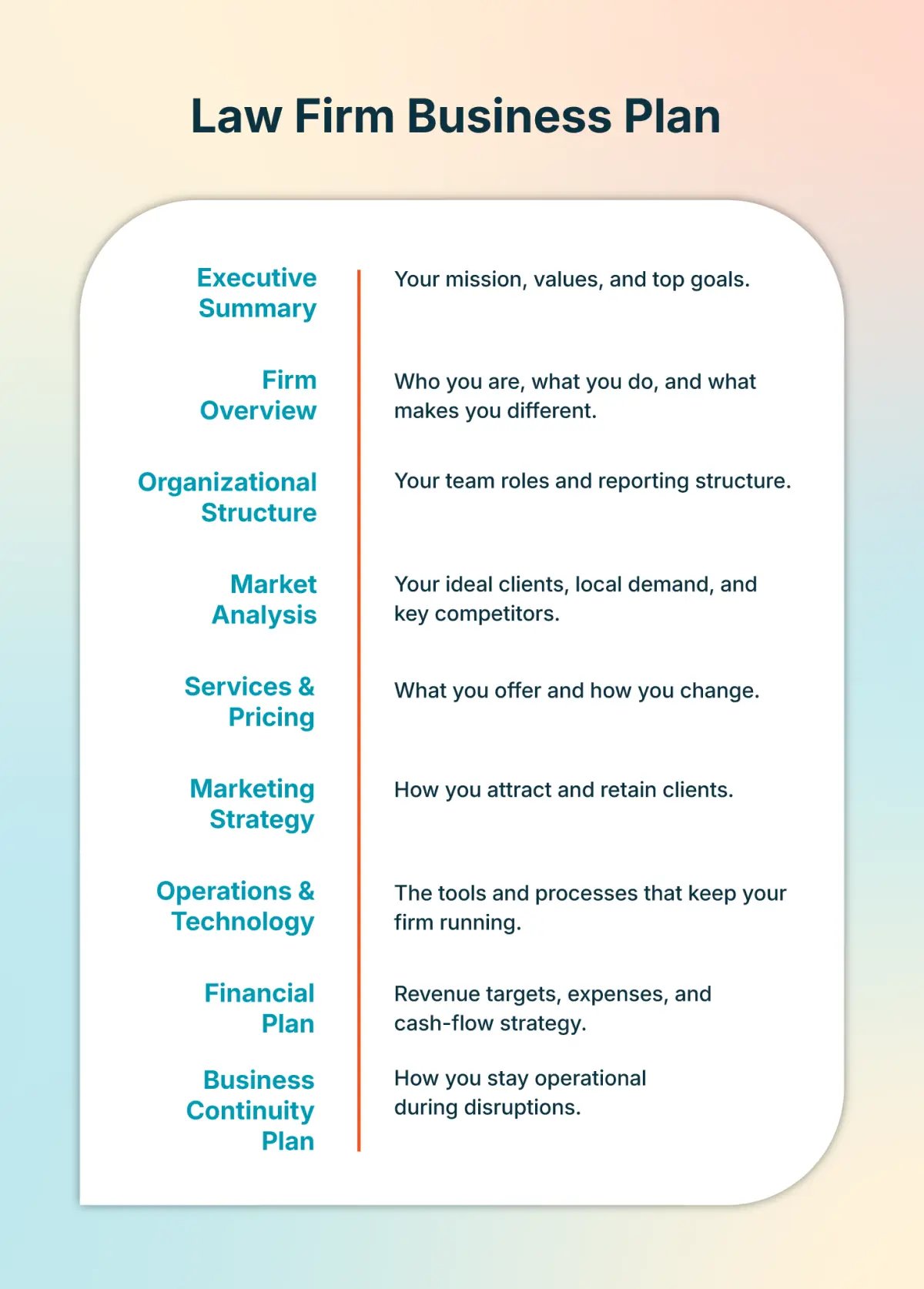
Once you feel confident about your new practice venture, it’s time to write a business plan . A business plan documents key issues that will shape your practice. It defines your firm’s specialty area, strategy, finances, competition, target client base, market size, technology plan, and expected cost structure.
The value of having a written business plan is twofold. One, the exercise of producing it encourages you to answer questions that will influence your future decision-making. The completed document then serves as a business roadmap.
Secondly, a business plan can help you obtain financing or new partners.
Specifics to consider before you write a business plan include:
-
Your firm name and practice area
-
Whether you will work from home, a coworking space, or a dedicated office
-
The type of cases or clients you want, and why
-
Your expertise and how it benefits your target client base
-
What business structure fits your needs, and how it impacts your taxes and your law firm’s tax deductions
-
Your network of contacts and how they can support you
-
How will you manage records and documents
-
What equipment and technology do you need
-
Whether you need financing
-
Your law firm's budget goals in the short, medium, and long term
-
What type of marketing will you do
-
Your law firm growth objectives
-
Who can handle your active client matters if you are incapacitated
Thinking through those details will help you develop a solid and functional business plan. Typically, business plans are organized around these topics:
-
Executive summary that defines your mission, values, and top goals
-
Firm overview
-
Organizational structure
-
Market analysis
-
Your services and pricing
-
Marketing plan
-
Operations and technology
-
Financial plan
-
Business continuity plan
You may want to review the New York City Bar’s walk-through of how to write a law firm business plan .
3. Choose your office location
Your office location is an early decision point that affects privacy for you and your clients, as well as your law firm's branding. The three main location options are leased office space, co-working space, and home office.
Leased office space
Greater control over privacy and branding is the primary advantage of leasing office space. This type of space usually feels more separate and confidential than a home office or coworking area. That separation provides more peace of mind for clients and benefits you also—at day’s end, you can leave work at the office and fully disengage at home. Additionally, you can use the office location as your business address, which keeps your home address out of the public record.
From a branding perspective, a commercial office implies permanence and stability, which may be necessary to secure certain client types.
Unfortunately, a leased office space can be the most expensive element of your firm’s launch. It may require a multi-year lease and a personal guarantee. You will also have to invest in furniture, utilities, internet connection, and cleaning.
Coworking space
Coworking spaces offer a separation between work and home life at a lower financial commitment than a leased office. You can find co-working spaces with month-to-month agreements, which makes it easier to move locations in the future. Many include internet access, rentable conference rooms, and a reception desk. Some also have furniture.
The downside of a coworking space is less control over privacy. Thin office walls combined with a shared printer, internet, and waiting area present confidentiality challenges. Some clients may feel uncomfortable meeting in that environment.
Home office
Working from home eliminates rent from your operating budget. It also reduces commuting costs, since you won’t be driving to work or parking downtown every day.
Like a coworking space, the home office lacks privacy. At a minimum, you need a locked cabinet for files and a secluded area for private conversations and remote meetings. You likely don’t want to host face-to-face meetings at home—those require a rented conference room.
Note that many states require a physical street address for entity formation and bar registration, which puts your home address in the public record. Some states also require you to include a physical address on your advertising, including the firm’s website. A virtual office address can be a viable workaround, but first, verify your state bar accepts it. Remember to include the virtual address in your cost projections.
4. Form an entity
Once you finalize your work location and official business address, you can establish your business as a legal entity. The entity type you choose affects your taxes and personal liability for the business actions and debts. Generally, the popular options for law firms are:
-
Limited Liability Partnership (LLP)
-
Limited Liability Company (LLC)
-
Professional Corporation (PC)
-
Sole proprietorship
Each has different rules and costs, so make sure you pick the one that fits you best. This is also the point at which you will pick a name for your business.
Once you’ve set up an entity, the last step is to apply to the IRS for a federal Employer Identification Number (EIN) .
5. Bank accounts and insurance
Banks require your entity formation documents and EIN. Once you have these in hand, you can set up accounts to hold your business cash plus insurance to protect it.
Bank accounts
Establishing financial accounts for law firms is significantly more complex than for other types of businesses due to ethical rules and trust-accounting compliance requirements. Your firm must establish at least two bank accounts: an operating account and an IOLTA (Interest on Lawyers' Trust Account) account.
The exact rules for IOLTA compliance vary somewhat by state. Review them carefully. A primary concept to understand is that you can’t commingle operating and client funds . Your technology solutions and bookkeeping processes must support that rule. If you plan to offer modern payment options like credit card payments or eChecks, using fully compliant legal payment software is a must.
Malpractice insurance
The trust account structure protects your clients, while insurance protects you. Plan on securing malpractice insurance, even if your state doesn’t require it. Normally, entity structures can’t protect you from your own negligence—but insurance can.
According to the ABA, solo practitioners are far more likely to face a malpractice claim during their careers than those in larger firms. Forgoing insurance is therefore not an option. That would put your personal assets at risk in every matter.
6. Establish your brand and marketing
Earning new clients and retaining them is how your business will grow and prosper. But there’s a lot of competition in the law firm industry today, with 412,000 firms in 2026 . Your first line of offense in that environment is your professional network—it is the lowest-cost form of law firm marketing available to you as a solo practitioner.
Reach out to other attorneys you know and build a referral network spanning various practice areas. When you meet prospective clients who don’t fit your strategy, refer them to someone in your network. The other lawyer will likely return the favor.
Note that networking and other marketing strategies perform better when you have these foundational elements in place first:
-
A website and logo: Consider hiring a professional designer to create your website and logo. Unprofessional marketing materials make poor first impressions, regardless of how talented a lawyer you may be.
-
Lead tracking/client intake system: You need a system to ensure every lead gets a quick return phone call. You might start with a spreadsheet, but look to automate this functionality as your business grows. Automation can expedite your response time and prevent missed opportunities.
-
Social media profiles: Publishing on social media allows you to reinforce your branding and connect with prospective clients, free of charge. Your social media content introduces prospects to your professional persona and the type of legal work you do in a more dynamic way than your website. This can improve lead conversion among those who research your entire online presence before reaching out.
If you are tracking which sources generate leads, you can tailor your marketing efforts over time to focus on what’s working for you.
7. Staffing
Effective marketing and happy clients will increase your caseload and create the need for a staffing strategy . While you may plan to start out independently, your business will evolve through several growth phases, including:
-
Operating solo with no staff: You handle all the work, using software and services to fill the gaps. You might retain a virtual receptionist, an outsourced bookkeeper, and practice management software with deadline tracking and automations, for example.
-
Part-time support staff: As the client load builds, so does your administrative burden. Your first hire may be a part-time virtual assistant or paralegal to handle high-volume, low-risk tasks such as document collection, data entry, and scheduling.
-
Full-time assistant or paralegal: If you’re turning away work or working long hours for weeks, that may be a cue to bring on a full-time paralegal or assistant. Make sure you’re not hiring for expected work or during an unusually busy period. The workload needs to be sustainable.
-
Second attorney: If your time constraints are inhibiting the firm’s growth, you may need an associate or an of counsel lawyer.
You may want to define revenue, case load, or other milestones that signal when it’s time to hire administrative staff, paralegals, or attorneys. Typically, you’ll find yourself working too many hours on lower-level tasks or bogged down with managerial responsibilities . When that happens, verify these factors are true before recruiting a new team member:
-
You have the bandwidth to train and supervise.
-
The workload is sustainable.
-
The bottleneck requires a human and cannot be addressed with software.
From a cost perspective, plan on each new hire costing 1.25 to 1.4 times salary. The costs beyond salary include employer payroll taxes, health insurance, workers’ compensation, software licenses, equipment, and a retirement match, if offered.
8. Succession planning
A succession plan documents how client matters should be handled if the lawyer can no longer provide representation. The document is not created to prepare for your retirement—it is intended to protect your clients if something happens to you. Failing to create a succession plan risks violating several ABA Model Rules. It may also violate state regulations. Most states either recommend or require law firms to document clear succession steps.
Topics to cover in your succession plan, according to the ABA , include:
-
A named successor attorney (licensed in the same jurisdiction) to handle active matters
-
Details on how the successor will be compensated
-
Information on how client information is stored
-
Computer and voice mail passwords
-
Operating and trust account information
-
Instructions for disposing of closed client files
-
Details about office equipment leases, contracts, vendor payments, and other liabilities
Your succession plan should be dated and signed by you and your successor attorney. Revisit it annually to ensure the information remains current and accurate.
9. Design your law firm technology stack
As you go through the planning process for launching your practice, you will identify gaps that can be solved with the right legal technology . For example, cloud-based systems store documents and client information securely, and legal customer relationship management applications, or CRMs, help you track leads. These solutions can lessen your administrative burden and improve client experience, two benefits that help your law firm scale successfully.
Legal technologies to consider include legal practice management software, legal intake and answering services, and legal payment processing solutions.
Legal practice management software
Practice management software holds client data in one secure, centralized location. It can also drastically increase efficiency when multiple individuals work together on a case, reduce the risks of misplaced documents or information, and improve client satisfaction.
A good case management solution should have several features, including:
-
Client intake
-
Matter tracking and management, including the ability to share documents and data between different matters for the same client
-
Up-to-date forms and document templates
-
Ability to create custom workflows
-
Secure client communication and document portals
-
Time tracking
-
Calendaring and scheduling
-
Email monitoring
-
Legal practice guides
-
Built-in AI features
Cloud-based practice management solutions, like 8am MyCase , are ideal for new practices because of their ease of use and security. Plus, they give you maximum flexibility by allowing you to work from anywhere, and they are regularly updated to stay current with evolving cyber threats, client expectations, and legal requirements.
Legal intake and answering services
Specialized legal intake and answering services save you time and improve your new practice’s professional image. You can choose the level of service you need: Some service providers only answer client communications, while others also complete new client intake. Find a provider that will handle call answering and client intake based on your criteria and preferences.
Legal intake and answering service benefits may include:
-
All phone calls to your practice are answered by a live human
-
Callback information is collected from all callers when you can’t take the call
-
Multilingual support for law firms serving non-English speaking clients
-
Intake data collection so you can focus on legal work
For a new law firm, outsourcing call answering and client intake is usually more cost-effective than hiring receptionists, legal secretaries, or paralegals to handle these tasks. Compared to letting phone calls go unanswered, retaining a call answering and intake service improves client satisfaction and lead conversion. People appreciate reaching a human every time they contact your firm.
Legal payment processing solutions
When considering the various law firm payment methods and processing solutions on the market, there are two main things to consider as a legal professional:
-
Is the solution up to date with state ethics and IOLTA compliance rules?
-
Does the application offer a modern experience that clients expect?
In this age of technology, people expect the option to pay digitally. If you don’t offer online payment, some clients may seek representation elsewhere, especially those who plan to pay for your services with a credit card.
Other tangible business benefits of electronic payment processing include:
-
You can immediately invoice clients and provide them with automated, regular reminders of outstanding invoices.
-
Allowing clients to pay your invoices upon receipt minimizes delays between performing the work, billing, and getting paid.
Legal payment software like 8am™ LawPay also supports seamless integrations with your existing accounting, case management, and other software solutions. This helps ensure every payment is accounted for, which is essential for regular reconciliations and strategic decision-making.
Supporting new law firms with best-in-class software solutions
Is it hard to start your own law firm? Yes. Are there tools and strategies to make it easier? Also, yes. If you have the drive, resources, and entrepreneurial spirit, launching your own practice could be the most rewarding step of your career. Among those must-have resources are legal software applications that streamline the administrative side of law firm operations.
Two popular options trusted by small firms are LawPay and MyCase. LawPay’s legal payment software offers convenient credit card options and other digital payments, plus billing tools that free up time you would otherwise spend on manual data entry and invoicing. And MyCase is a comprehensive case management solution with time entry, invoicing, document storage, and a client communications portal.
Learn more about LawPay and MyCase to see how these platforms can streamline operations for your new firm.
